Holy Warrior is the ethical ideal of Alpagut: TÖRÄ, ÄRDÄM and DENGE, the nine qualities of an Alp and one principle: strength gives no rights, it brings responsibility.
Holy Warrior
What kind of person an Alpagut fighter should be
Holy Warrior is the name Alpagut gives to its ideal of a person who has mastered a martial art. It is not a religious title or a grade, and no one is ever awarded it. Alpagut is not tied to any religion and does not serve political ends. The warrior it describes belongs to sport and to the shaping of character.
The word “holy” does not make anyone a saint. It points to what an Alp must keep inviolable: their given word, TÖRÄ and the dignity of another person. The origin of the name is covered in What Is Alpagut?, so this page turns to another question: what kind of person should someone become while learning to strike, throw and hold down an opponent?
Strength brings responsibility
Strength gives no rights.
It brings responsibility.
The greater the skill, the more a person answers for how they use it. The canon of Alpagut puts it this way: a grade is not a garment you put on but a responsibility you carry.
To an Alp, an opponent is not an enemy but a partner in the test. Only permitted techniques are used. If an opponent is injured, the bout is stopped and helping them comes first. At the start and the end of a bout the opponents exchange the HA salute: when the fight is over, the hostility is over too.
Outside the training hall an Alp does not look for confrontation and keeps a cool head in a conflict. Strength is used only in defence of oneself or another, and an Alp is never the aggressor.
The same applies to a teacher’s authority. Students follow their teacher’s technical instructions, but they do not have to obey an instruction that harms their health, degrades their dignity or breaks the law. Such an instruction breaks the teacher’s own ÄRDÄM.
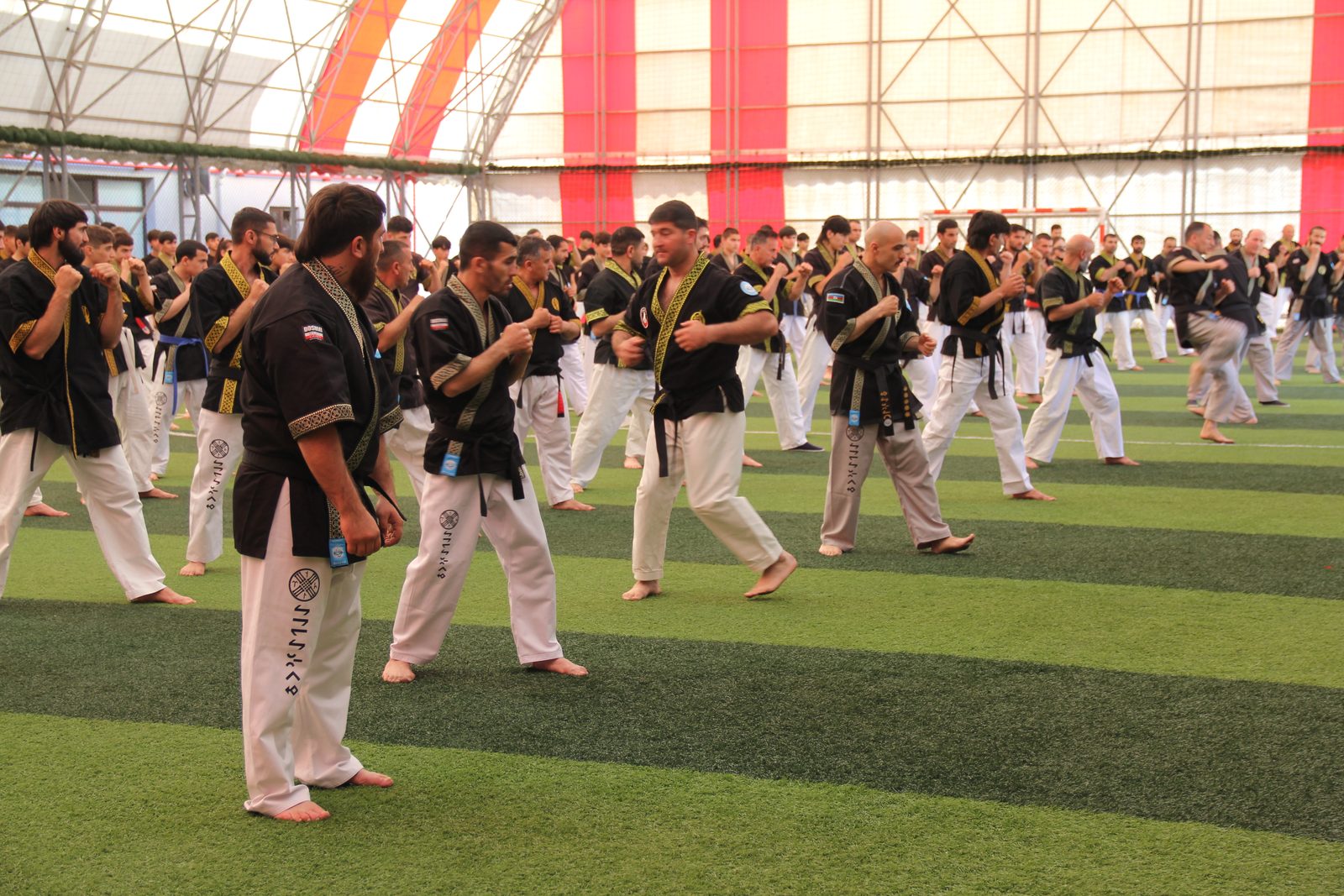
Three pillars: TÖRÄ, ÄRDÄM and DENGE
The ethics of Alpagut rest on three concepts. TÖRÄ defines what is right. ÄRDÄM answers the question of what a person should be and how they should act. DENGE sets the measure. A Holy Warrior is a person in whom all three are joined with strength and skill.
TÖRÄ— order
TÖRÄ is an old Turkic concept of moral and legal order. In Alpagut it is the ethical backbone of the whole art. It rests on four unchanging principles: KÖNİLİK, justice; UZLUK, benefit and good done to others; TÜZLÜK, equality; and KİŞİLİK, humanity. Equality means that women and men receive the same respect and the same opportunities, and that a grade is earned only through work and dignity. Humanity includes nobility, honesty and self-mastery. No governing body, the federation included, can revoke these principles.
ÄRDÄM— character in action
ÄRDÄM means dignity and virtue. In the canon the word has two meanings: one of the nine qualities of an Alp, and the whole code of an Alp’s everyday conduct. ÄRDÄM turns TÖRÄ and the nine qualities into deeds: in the training hall, at competitions, at home and at work. The rule is simple: TÖRÄ learned in the KORGAN (the name Alpagut gives to its training hall and school) remains TÖRÄ for life.
DENGE— measure
DENGE is the balance of opposing forces, the hidden axis of the art. At its root lie two forces, as Alpagut understands them: KUT, the share a person is granted — blessing, fortune, success and the right to rule — and AKIN, the living force that sets it in motion. KUT is the fixed foundation; AKIN moves it, and the balance between the share given and what a person does with it is the ground of DENGE. When there is much foundation and little movement, a person freezes like a stone. When there is much movement and little foundation, strength turns blind: it destroys everything around it and in the end destroys itself. An Alp is born where the two forces work together.
Balance does not mean standing still. A master loses it too, but regains it faster than others.
Nine qualities in technique
The qualities of an Alp are not taught apart from technique. The KAÇUT system has nine official YÖRTEM forms, one for each grade from ALPATAÇ to YARĞAN. Each form joins one of the nine technical bases to one of the nine qualities and shows what that quality looks like in motion.
| Quality | Technical base | Meaning of the form |
|---|---|---|
| ERLİK — courage | hand strikes (KOL) | the first step |
| SAYGI — respect | kicks (TEPİK) | strength under control |
| BİLGELİK — wisdom | manoeuvre and defence (AYÇA, KORUY) | seeing all four sides |
| DOĞRULUK — truthfulness and justice | throws (ATIŞ) | throwing with measure |
| ÄRDÄM — dignity | sweeps (BADALAG) | bringing someone down without humiliating them |
| ÇIDAM — endurance | joint locks (BAĞDAMAK) | patience and control |
| KÖNÜL — mercy | chokes (BOĞUÇAN) | knowing when to let go |
| UCALIK — magnanimity | weapons (YARAK/YASAK) | the responsibility of strength |
| BAĞLILIK — loyalty | the unity of the nine bases | loyalty to TÖRÄ keeps the path whole |
Chokes and weapons show this most clearly. A choke tests whether a person can let go in time. Weapons training tests whether they understand that strength places responsibility on them. The nine qualities are part of the grading examination too, and the examining board assesses them together with technique.
Beyond the KORGAN
The canon does not split an Alp’s life into the training hall and everything else. At home this means respect for parents and care for elders and the young. At school and at work it means honesty. An Alp keeps their word. When speaking about the art, an Alp says only what sources confirm, does not belittle other martial arts and does not present Alpagut as the best of them.
In another country an Alp respects its laws and customs. An Alp does not divide people by language, faith, origin, homeland or sex, treats the beliefs of others with respect and stays out of religious disputes. An Alp does not turn the art into a tool of any party.
The founder’s Charter says it plainly: the art is Turkic in origin, and its doors are open to all of humanity. That is why an Alp does not place themselves above other peoples. Aggressive nationalism and the humiliation of other cultures are forbidden. The canon sums it up in a single line: an Alp shows who they are by conduct, not by words.
When an Alp makes a mistake
The ideal does not demand perfection. The canon says: a mistake does not cost a person the name of Alp; refusing to admit it does. The way to put things right is described too. One must honestly admit the fault and apologise, then repair the harm where possible, change one’s conduct and return to training.
Loyalty has a limit as well. Loyalty to a teacher does not stand above TÖRÄ, and hiding a mistake is not loyalty. Harm, insult and any threat to safety are never covered by confidentiality: in such cases a student turns to their parents, the head coach or the federation, whose Safeguarding Policy sets out what follows. The rule “what happens in the KORGAN stays in the KORGAN” covers a training partner’s weaknesses, slips and private matters.
A lifelong path
Everyone who practises Alpagut is called an Alp, whatever their grade. No board decision or examination makes anyone a Holy Warrior: an Alp moves towards this ideal throughout life. DENGE describes the path as four circles, each wider than the one before.
- ÖZthe self
An Alp first learns to master body and character. ERLİK without ÇIDAM, courage without endurance, becomes destructive.
- OCAQfamily and the generations
An Alp keeps the bond with the elders and raises those who will come after.
- ELsociety
A person’s freedom is balanced by responsibility to others, and the common order by respect for everyone’s dignity.
- EVRÄNthe cosmos
An Alp remembers being part of the world and treats nature with care.
The circles do not replace one another. Maturity means holding all four in balance at once.
“An Alp is known not by technique but by ÄRDÄM. The word of an Alp is an oath; the conduct of an Alp is TÖRÄ.”
The principle of ÄRDÄM in the words of KUTSAN, founder of Alpagut
See also
Where to train in Alpagut
Contact the federation’s national representative in your country.
Find a representativeWorld Alpagut Federation — international governing body for the sport of Alpagut, established 2014, present in 50+ countries.